
San Patricio Supervision Types
Parole, mandatory supervision, and probation are separate legal paths. Parole is a discretionary release from Texas Department of Criminal Justice confinement. The person serves the rest of the sentence under rules enforced by the TDCJ Parole Division. Mandatory supervision is a statutory release structure based on legal eligibility, calendar time, good-time credits, and, for many cases, approval by the Texas Board of Pardons and Paroles. It is still state supervision after prison or state-jail custody.
Probation is formally called community supervision in Texas. A court imposes it, often instead of confinement, and the local Community Supervision and Corrections Department administers it. Thus, a San Patricio County probation entry does not prove a TDCJ release. The judgment is the best starting document because it identifies the sentence, court, and supervision type.
| Feature | Parole or mandatory supervision | Probation |
|---|---|---|
| Authority | TDCJ Parole Division and BPP | Sentencing court and local CSCD |
| Custody link | Follows TDCJ confinement | May be ordered without prison |
| First record | TDCJ offender details | Court judgment or docket |
| Local route | Corpus Christi District Parole Office | San Patricio County CSCD in Sinton |
Verify San Patricio Parole
Start with the official TDCJ offender search for a person who served a Texas prison or state-jail sentence. A TDCJ number or State Identification number gives the strongest match. If neither is known, use the name fields and compare the age, offense, conviction county, and other identifiers. Open the full record. The Parole Review Information area may show review or decision data, while the location and status fields help distinguish confinement from parole.
A release date and parole status are not the same field. A projected date is a calculation. A scheduled date is later planning data. Actual release to parole begins supervised time, while discharge means the applicable sentence or supervision term has ended. One cause can end while another remains. For that reason, read labels closely and use the BPP result instructions when the review status needs clarification.
- Gather the full name, date of birth, TDCJ number, or SID.
- Search TDCJ and compare identifiers before opening a match.
- Read custody status, release fields, and Parole Review Information separately.
- Call the published BPP status line at 844-512-0461 when a decision needs confirmation.
- Use the live TDCJ directory to confirm the assigned parole office.
San Patricio Probation Records
For county probation, obtain the sentencing order from the clerk that handled the criminal case. The San Patricio County Clerk routes misdemeanor criminal records. The District Clerk handles felony district files. A docket can point to a judgment, order modifying conditions, revocation filing, or discharge order, but it may not disclose protected supervision details. Ask for the named public document rather than a broad conclusion about the person.
The San Patricio County Adult Probation page identifies the local Community Supervision and Corrections Department. CSCD can provide authorized verification or reporting directions. It is not a parole locator. Do not ask it to confirm a TDCJ parole case merely because the person lives in San Patricio County.
404 West Market Street
Sinton, TX 78387
361-364-4243
Director: Jason Woods
Contact the correct clerk first when the supervision type is unclear. The judgment provides the legal link. The CSCD then supplies the local route for a probation matter, subject to confidentiality rules.
Regional San Patricio Probation Office
The Sinton CSCD office has an unusual regional role. TDCJ’s CSCD location directory lists San Patricio as the contact county for Aransas, Bee, Live Oak, and McMullen as well. This arrangement explains why a person connected with a nearby county may be routed through the Sinton community-supervision office.
That regional reach must not blur the legal line between agencies. CSCD administers court-ordered community supervision. It does not make parole decisions and is not proof that a named person left TDCJ custody. The BPP decides parole matters, and the TDCJ Parole Division supervises approved parole and mandatory-supervision cases. Confirm the case county and judgment before calling.
The distinction also matters after a San Patricio County Jail release. Bond can place someone under pretrial conditions, which are not probation. A transfer to TDCJ is not community release. A sentence of probation comes from the court, while parole begins only after state confinement.
San Patricio Parole Review
Texas does not hold a conventional public hearing with a public calendar for ordinary parole or mandatory-release consideration. The BPP parole panel FAQ explains that panel members review case files and vote individually. An Institutional Parole Officer prepares a case summary. TDCJ generally identifies a case months before eligibility, but timing varies and eligibility is only the first chance for review.
A three-member panel votes in sequence, and two matching votes establish the result. Texas uses detailed codes. FI-1 and other FI codes reflect favorable actions with different timing or requirements. RMS concerns release to mandatory supervision. NR sets another review, SA means serve all, and other codes can address treatment, further review, or denial. Check the exact meaning in the official BPP vote options. Approval may still be withdrawn if new facts emerge or required steps are not met.
Government Code §508.145 governs eligibility with offense-specific law. Eligibility never guarantees release. Registered victims may receive review notices through authorized services, but there is no general courthouse-style schedule to browse.
The assigned manifest image comes from the official Texas parole review process.
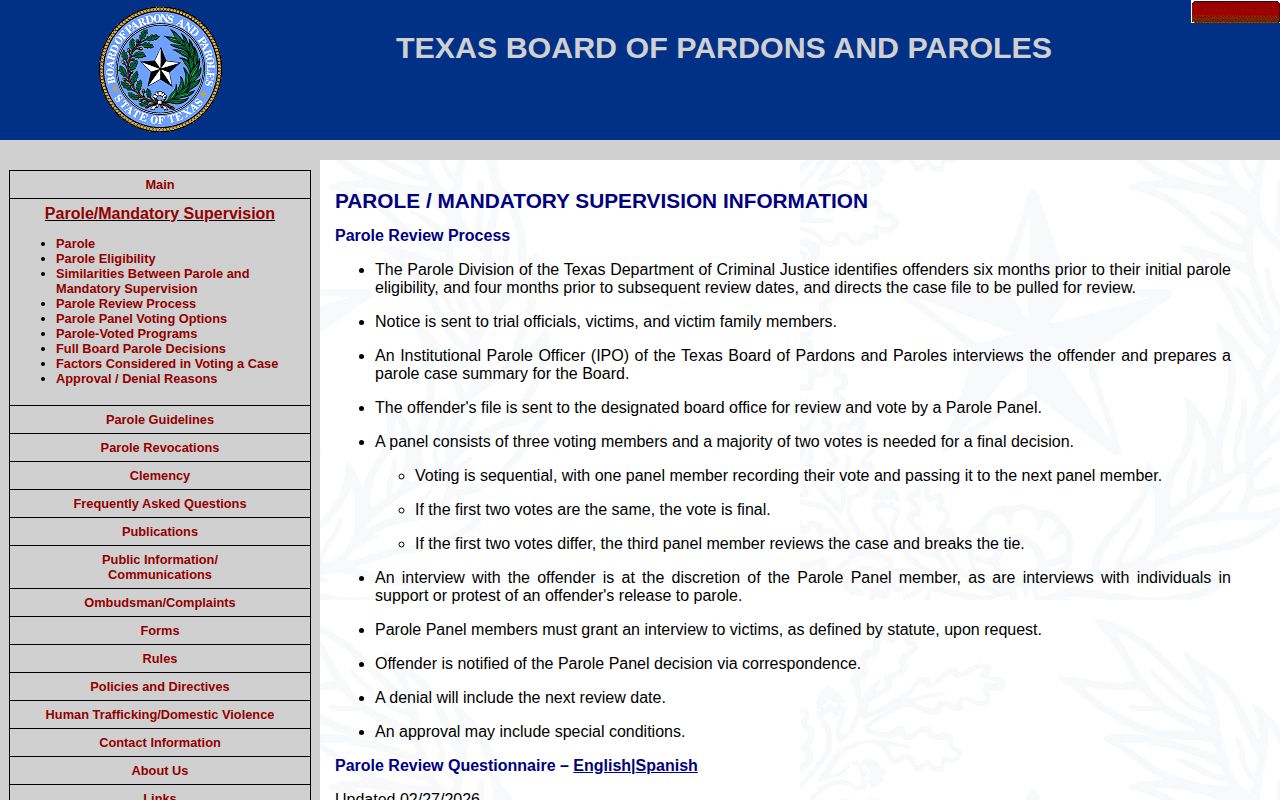
The screen helps identify the state file-review route, not a local public hearing calendar.
San Patricio Supervision Alerts
TDCJ IVSS is the state notification system for TDCJ custody, parole review, release, and supervision events. Search by name, SID, or current TDCJ number, open the record, then subscribe if the available event types match the need. Notifications can assist with timely awareness, but they are not certified orders and may lag.
The TDCJ IVSS registration portal is separate from Texas IVSS-Counties. The county portal deals with participating county jail and court records. Neither local probation status nor a TDCJ parole decision should be inferred from the wrong portal. Existing registrations migrated from older VINE systems, so contact settings should be reviewed.
The matching manifest image shows the state registration and notification entry point.
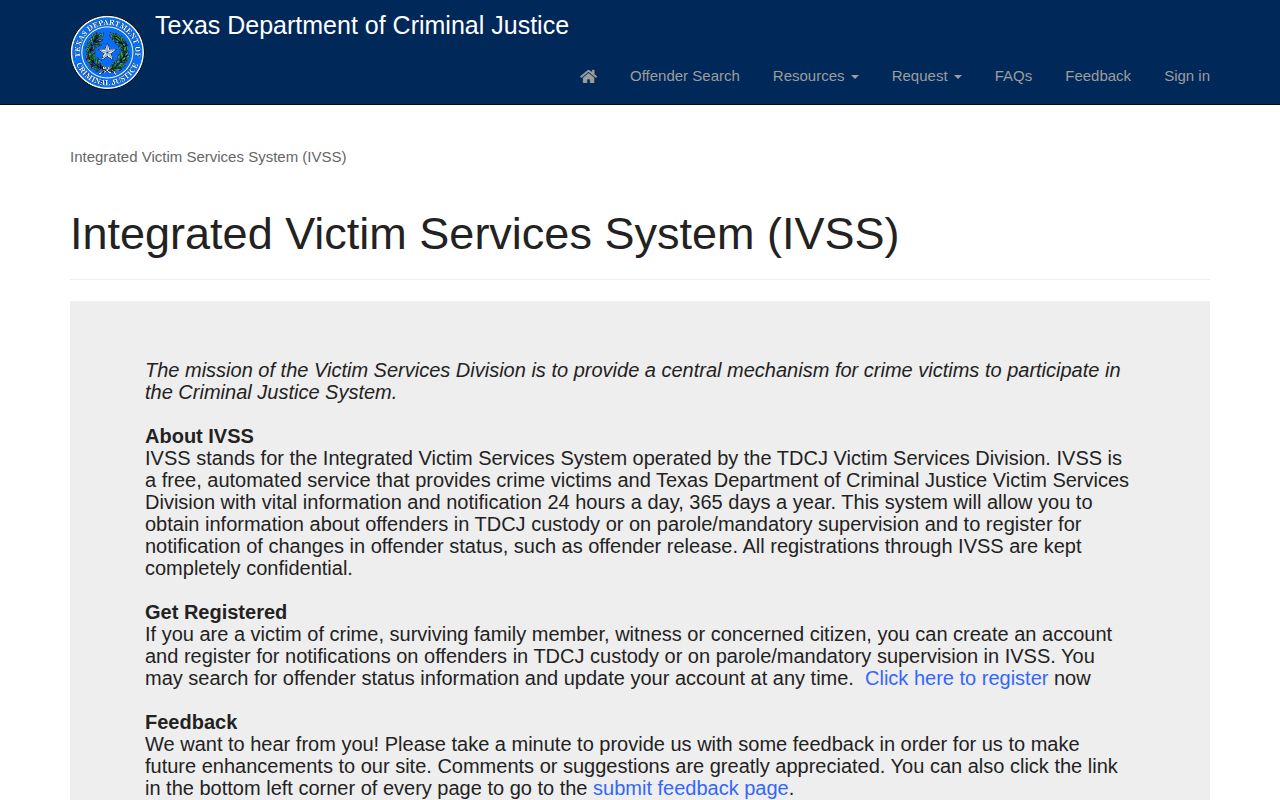
After signing in, confirm that the selected record and event choices belong to the correct TDCJ case.
San Patricio Violations and Discharge
An absconder is a person whom the supervising authority alleges has stopped reporting or cannot be located as required. A warrant may follow an alleged violation. Neither label erases the original release. No official San Patricio County public absconder list was found, so status should be confirmed with the issuing court, law-enforcement agency, TDCJ record, or supervising office.
Conditions can include reporting, travel limits, treatment, fees, or other case-specific terms. Public records rarely expose a full day-to-day supervision plan. A violation allegation can lead to a separate revocation process, and the BPP revocation process is distinct from ordinary parole review. Probation violations proceed through the sentencing court.
- Parole
- Supervised service of the remaining state sentence after discretionary prison release.
- Probation
- Court-ordered community supervision that may occur instead of prison.
- Mandatory supervision
- A statutory TDCJ release path governed by time credits, eligibility, and review rules.
- Absconder
- A person alleged to have stopped complying with required supervision contact.
- Discharge
- The end of the stated sentence or supervision term, subject to any other case.
A discharge record deserves the same careful match as a release record. Confirm the cause, agency, and date. For the broader county release trail, use the San Patricio County released-inmate search.