
San Patricio Release Date Types
A projected date is conditional planning data calculated by TDCJ Classification and Records. It draws on the offense, offense date, sentence, calendar time, applicable credits, mandatory-supervision law, and Board decisions. Parole could occur sooner. A denial of discretionary mandatory supervision can move the projection to maximum expiration. A new approval or corrected record can cause another calculation.
A scheduled release date and scheduled release location may appear after a favorable decision and required processing. Those fields are closer to the release event, yet TDCJ warns that a scheduled date can change without notice, even on that day. Actual release means the custody exit occurred. Discharge means the specified sentence or supervision term ended. These labels must not be collapsed into one date.
| Date field | What it means |
|---|---|
| Parole eligibility | First legal review opportunity, not a release promise |
| Projected release | Conditional TDCJ calculation under applicable law |
| Maximum sentence | Sentence-expiration field, subject to the full record |
| Scheduled release | Later processing date that can still change |
| Actual release | Recorded completion of the custody exit |
Find San Patricio TDCJ Dates
Use the TDCJ Online Inmate Search only for a person who entered Texas prison or state-jail custody. It does not cover every person booked into San Patricio County Jail. A TDCJ number or SID gives a better match than a name alone. If only the name is known, use the displayed refinements and compare age, conviction county, offense, and sentence before trusting the record.
- Open the official TDCJ search and enter the TDCJ number or SID when known.
- Otherwise search by surname, first-name initial, and available refinements.
- Compare identifiers and conviction details before opening the record.
- Read Projected Release, Parole Eligibility, Maximum Sentence, and Scheduled Release separately.
- Recheck near the expected date and confirm through TDCJ.
The assigned manifest view comes from the official TDCJ search form.
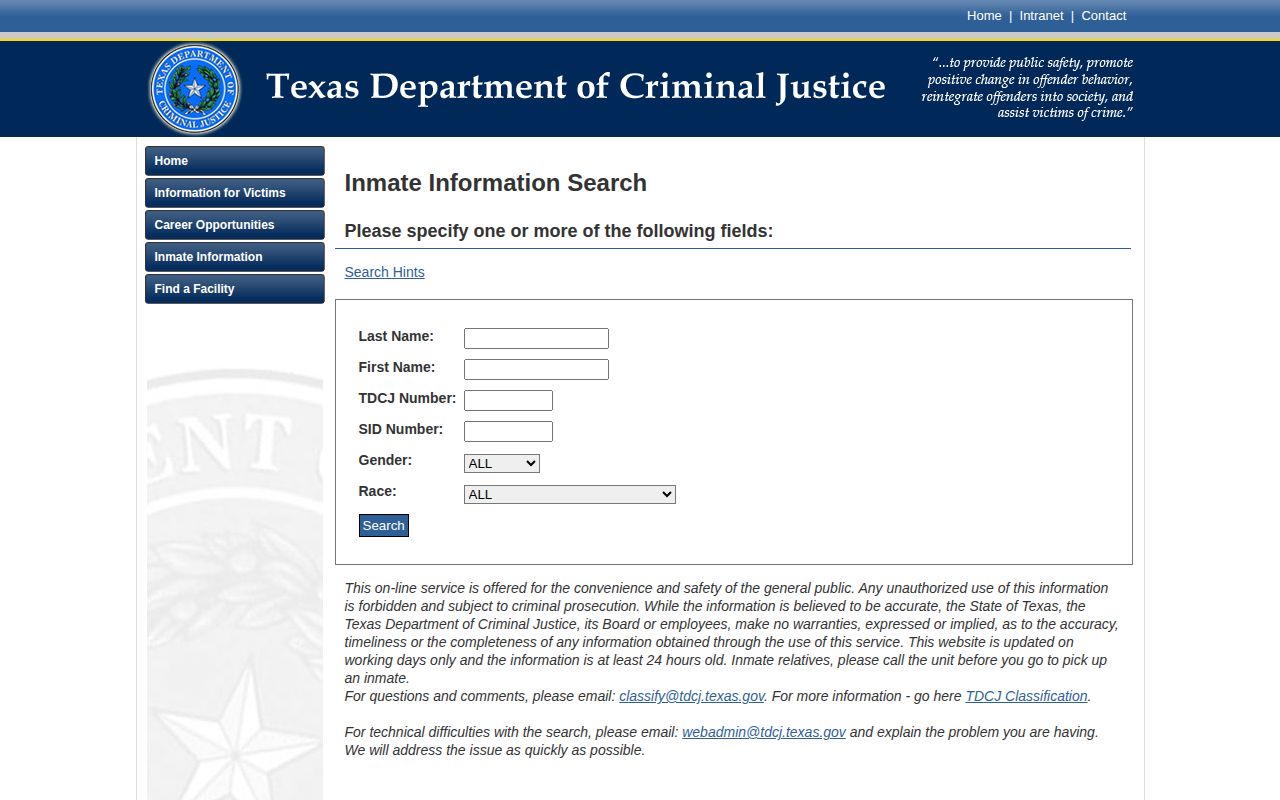
The details screen, not a result row, is where distinct date labels and status fields must be compared.
San Patricio Projected Date Definition
TDCJ defines Projected Release Date as the date calculated by Classification and Records on which a person is projected to leave incarceration if not paroled sooner. The offense title and offense date matter. For eligible offenses committed before September 1, 1996, flat time plus good time may determine the mandatory-supervision projection. For later eligible offenses, discretionary Board approval is also required.
If the Board denies discretionary mandatory supervision, the projected date may be recalculated to maximum expiration. For a legally ineligible offense, the projected date generally aligns with maximum expiration based on flat time. Those rules show why a date cannot be estimated safely from the sentence length alone.
The TDCJ no-cost email information page gives the official definition and a fallback request route.
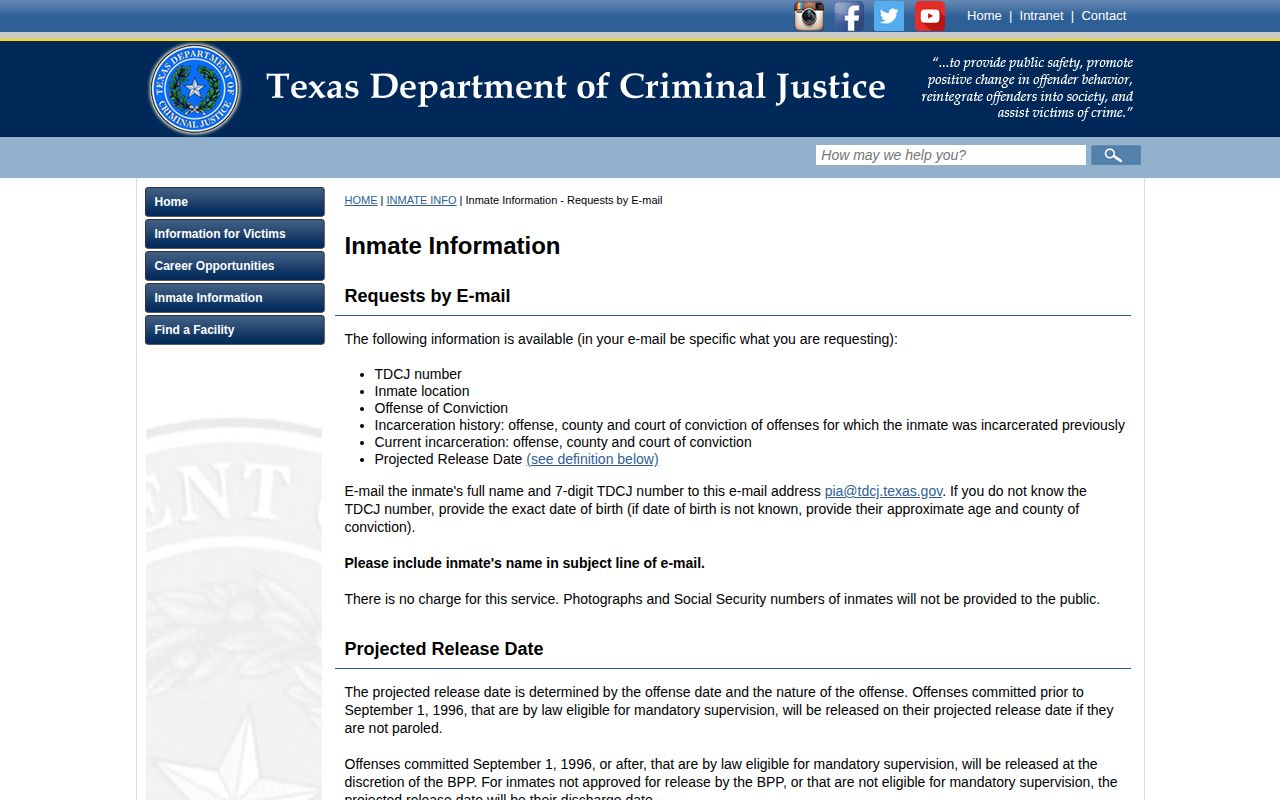
The email route requests a full name and TDCJ number, or identifying details such as birth date and county of conviction when the number is unknown.
Texas Good Time and Release
Texas Government Code §498.003 makes good conduct time a privilege tied to classification and qualifying participation. It affects eligibility for parole or mandatory supervision. It does not reduce the sentence itself, and credits can be lost. This distinction is vital: earned credits may change when review can occur without creating a guaranteed release date.
Government Code §508.147 describes a calendar-time-plus-good-time calculation for eligible mandatory supervision, while §508.149 lists exclusions and discretionary criteria. The Board still has a role in many cases. Offense date, offense type, and statutory eligibility must be checked from the actual record.
- Flat time
- Calendar time physically served toward the sentence.
- Good time
- Conditional credit affecting certain eligibility calculations, not the sentence length itself.
- Mandatory supervision
- A statutory release path subject to eligibility and, for many cases, Board review.
- Detainer
- A request or hold from another authority that may prevent community release.
No Universal Texas 85 Percent
Texas has no general rule that every prisoner serves 85 percent. Government Code §508.145 contains offense- and date-specific parole rules. For many serious offenses identified through article 42A.054 and deadly-weapon findings, subsection (d) generally sets first eligibility when actual calendar time, without good conduct time, equals one-half of the sentence or thirty years, whichever is less, subject to stated minimums and special offense provisions.
Eligibility is not release. The BPP may deny parole, set another review, or require steps tied to a favorable vote. Other offenses and dates follow other subsections. A person’s sentence papers and TDCJ details are therefore necessary before any calculation is discussed. Converting “one-half for eligibility” into a promised halfway release would be false.
Parole review also differs from sentence expiration. A favorable vote may lead to release processing, but program, legal, and release-plan requirements can still affect timing.
Why San Patricio Dates Change
Release calculations respond to legal and administrative events. Some move eligibility. Others delay physical release or change the agency that receives the person. The date should be checked again after any new court order, Board action, disciplinary event, or custody transfer.
| Factor | Possible effect |
|---|---|
| Good-time loss | Changes an applicable eligibility calculation |
| Board decision | Approval, denial, or later review may alter the path |
| New court order | Can correct or modify the legal basis for custody |
| Detainer or hold | May route the person to another agency |
| Release processing | Can produce a later scheduled date and location |
| Record correction | May cause TDCJ to recalculate displayed fields |
A transfer date is not a return to the community. Follow the receiving agency. If TDCJ receives the person from the county jail, move to the state offender record. If federal or immigration custody begins, use that system.
San Patricio County Jail Dates
County-jail calculations are different from TDCJ calculations. A pretrial detainee has no fixed projected date because bond, holds, and court action control release. A person serving a county sentence may have a calculation based on the judgment, jail credit, local sentence, holds, and applicable county-jail law or policy.
No official San Patricio published good-time formula or weekend-release rule was located. Do not apply the TDCJ projected-date formula to a county booking. Obtain the judgment from the correct clerk, then ask the San Patricio County Jail to confirm its calculation and any remaining hold. The jail record establishes the actual release time and disposition after processing ends.
- Determine whether the person is pretrial or serving a sentence.
- Get the judgment, sentence, and jail-credit notation from the court.
- Ask the jail to explain its current calculation for that booking.
- Identify every detainer and the agency that placed it.
- After release, obtain the actual timestamp and disposition code.
Confirm San Patricio Release
TDCJ offers online, email, and telephone information routes. Ask specifically for projected release, scheduled release, actual release, and current supervision status rather than simply asking for “the date.” Classification, time, transfer, and release questions can be routed through the published TDCJ contact at 936-437-6231 or classify@tdcj.texas.gov.
For a pending state or county event, VINELink Inmate Search explains the current Texas IVSS portals and notification steps. Alerts are useful, but agency confirmation remains necessary. A released person usually disappears from a live custody roster, so historical release data comes from the booking file, TDCJ details, and court record.
Close to the expected date, verify again. Ask whether the date is projected, scheduled, or actual, and whether release means community placement, parole, mandatory supervision, or transfer. Precise words prevent the most common error.
The no-cost TDCJ email service needs enough detail to identify the right record. Supply the full name and seven-digit TDCJ number when available. If it is unknown, the instructions allow an exact birth date or approximate age and county of conviction. Ask for each field by name so eligibility data is not mistaken for actual release.
A formal Public Information Act request is a different channel. For a disputed calculation, identify the sentence, cause, TDCJ number, and specific existing record sought.